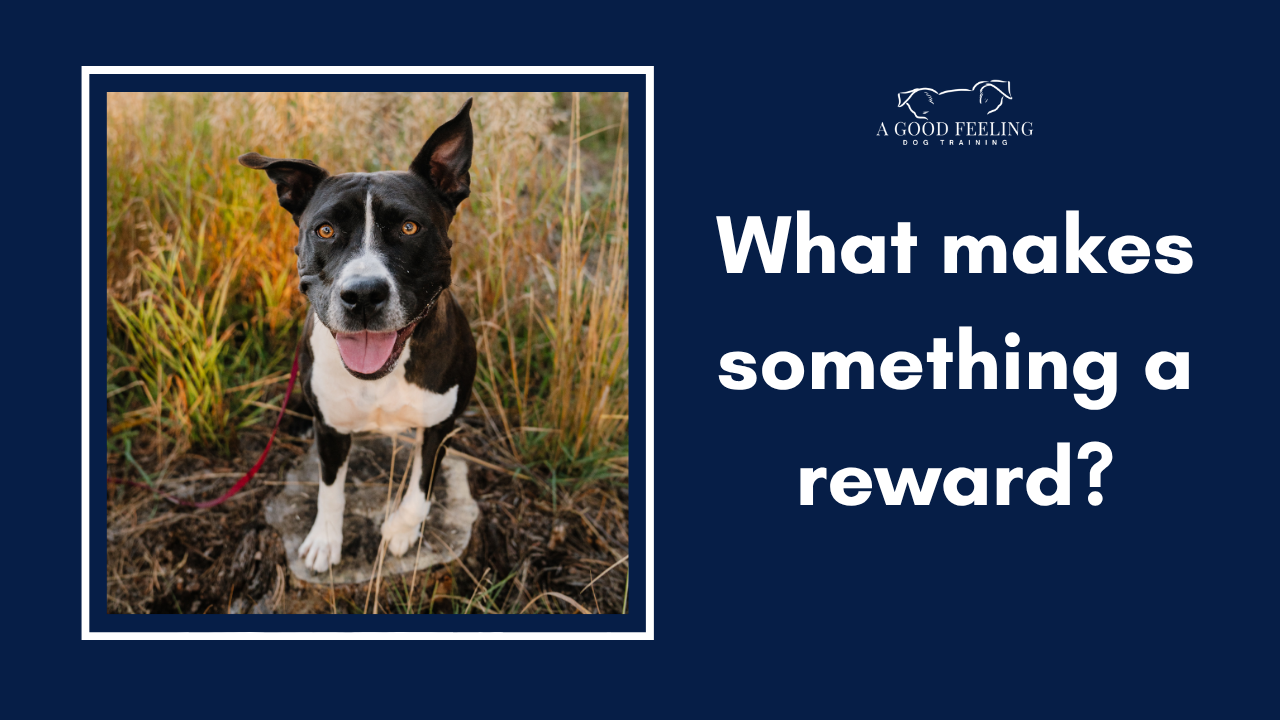
What makes something a reward?
Apr 14, 2026I think that when most people think about positive reinforcement training they always assume that a treat is the reward. The dog sits, they get a treat, voila, positive reinforcement. While a treat can sometimes be used as positive reinforcement the world of rewards and reinforcements is so much more than just a treat. Additionally sometimes a treat isn’t at all reinforcing to our dogs, it can sometimes be coercive or even negative. Today I am going to walk you through best practices for using rewards aka reinforcement to make the most of training with your dog.
First, your dog gets to decide what is rewarding, not you. I have worked with plenty of dogs over the years that didn’t think treats were reinforcements at all. In fact, they learned that when their humans brought the treats out it meant that something they didn’t like was going to happen. You have to look at your individual dogs and experiment with things that they are likely going to find rewarding. We also have to adjust to how our dogs are feeling in any particular situation. When it might be rewarding at home, it may not cut it when there are a lot of distractions. Waylon finds food pretty rewarding almost all of the time, but in certain situations he finds sniffs to be the most rewarding. Spicy on the other hand finds pets and praise rewarding almost all of the time and she finds toys and play rewarding at home.
When you are learning what your dog finds regarding it important to pay attention to the when and where. Waylon is much more motivated by food when he hasn't eaten in a few hours. Food loses a bit of its value when there are great sniffs or wildlife around. Spicy is much less inclined to find pets and praise rewarding when there are other dogs close by or prey animals running in her path. When it is hot out, food loses its value for both of my dogs. You see that your dog isn’t always going to find certain things rewarding and it’s up to you to learn the when and where for them.
As you start to learn the when, where and what is rewarding to your dog, that is when you can use it to your advantage in training. Many people are already familiar with the classic positive reinforcement strategy. Ask your dog to perform a cue, they do, you reward them with a treat. I want to help you understand the many other ways you can use positive reinforcement. I’ll give you a few specific examples.
- Prey drive. Spicy is a dog who thinks that bunnies, squirrels and basically any small animal should be chased. This is a behavior that I know is normal for her but I’d like to decrease. So at home she learned to leave it on cue, with food as the reward. As I started to generalize this cue outside, when she was thinking about chasing animals the food was not the most reinforcing reward in the environment. When we were out on a walk and she would see a squirrel, I would tell her to “leave it”, when she did I would mark “yes” and then let her get to the tree that the squirrel had just run up. Yes, you read that right, I used investigating where the squirrel was as the reward for not chasing the squirrel. This falls under the premack principle. While it seems crazy at first, these days Spicy doesn’t even attempt to chase the squirrel anymore, she can calmly observe the squirrel and move on without me having to say anything.
- Recalls. In Waylons lifetime I have focused heavily on off leash skills, one of which is his ability to come when called. This skill has no doubt been driven by food as a reward but what has been even more powerful of a reward for him has been more freedom after coming when called. Like all behaviors I started training his recall at home with low distractions but as I started to generalize his recall cue I started to add what we call a secondary reinforcement. Not only did Waylon get the reward of food when he came when I called him, I then released him back to sniff and explore after his food reward. The results really speak for themselves, these days Waylon comes almost 100% of the time when I call him.
- “Poisoning” food. I want to include an example of how we can actually “poison” something we think is rewarding for our dogs. Your dog displays a fear or discomfort of having their nails trimmed. So you grab a handful of treats and try to give them one after your dog has already decided they do not like what is happening to them. You try to give them the treat but they won’t take it. So you proceed to muscle them and clip their nail anyways, your dog resists and you try to give them a treat again. They refuse and the cycle continues. If you want to break the cycle, you will need to back up several steps and work at a pace they can handle.
The takeaway here is that when you can learn what your dog really finds rewarding, you can use that to reward less likely behaviors. You want your dog to keep their cool when greeting visitors, ask them to perform a stationing behavior for example,then release them to greet the guests as the reward. This will take repetition but when your dog learns that the only way to get a human's attention (which they really desire) is to keep their cool on their dog bed first, you’ll see their greetings improve drastically. You’ll also learn that while food can be useful it really isn’t always necessary to teach your dog new skills and to improve their ability to respond to your cues even with lots of distractions. A reward is anything that your dog wants at any certain moment. Positive reinforcement is at play, so much of the time for our dogs without us even knowing it. Rewards can be anything really, learn to pay attention.
-Rachel
Join our email list to be the first to know when a new blog has been published!
We promise not to share your info or send spam emails!